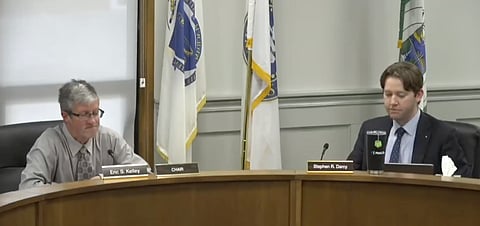


A brief 22-minute Select Board meeting Monday night exposed deep divisions between Marshfield’s two remaining board members over whether residents should be allowed to vote on a tax override, a decision that could determine whether town departments face up to $7 million in cuts.
The debate unfolded Monday night as the board, now reduced to two members after the resignation of Trish Simpson, grappled with how to move forward on major budget decisions ahead of town meeting. The disagreement centered on whether residents should be given the opportunity to vote on an override at the ballot box, an issue that quickly escalated into a broader dispute about transparency and leadership.
Without agreement between the two-member board to advance an override to the ballot, officials have indicated that reductions of that scale could impact municipal services, including Marshfield Public Schools, as the town works to close a significant budget gap.
Select Board member Steve Darcy framed the override process as one that should ultimately rest with voters, pointing to the steps already taken to include the issue at town meeting.
“In order for an override to go into effect, it's like a safety deposit box with two keys,” Darcy said. “The first key goes to town meeting, and the second key goes to the ballot box.”
Darcy emphasized that the board had already supported including override-related budget options in the town meeting warrant. He argued that the remaining decision — whether to place the question on a ballot — should not be withheld from residents.
“Are we going to give the voters a choice and give them a second key to vote on the override of the ballot box or are we going to swallow the key?” he asked.
Select Board Chair Eric Kelley made clear he would not support that step. When asked directly, he responded with a firm no and cited concerns about the financial burden on residents.
“Because I feel that we're spending too much and I think $7 million is going to put a lot of people out of this town,” Kelley said.
The exchange quickly became more pointed as Darcy challenged Kelley’s position, arguing that blocking a ballot vote would deny residents a fundamental role in deciding the town’s financial future.
"You're taking that choice away from 22,000 people," said Darcy, relating Kelley's position to the ongoing issues related to the MBTA Communities Act. "You're now doing [the same] to the voters of Marshfield by taking a choice away from them...the same thing you're upset with the state doing to us about taking local zoning choices away from the voters."
Kelley attempted to move the meeting forward to public comment, but the disagreement underscored the difficulty of governing with a two-member board that must reach consensus to take action.
Residents who spoke during public comment echoed Darcy’s concerns, urging the board to allow voters to weigh in directly on any override proposal. Several speakers framed the issue as one of democratic participation, saying residents should have the opportunity to decide whether higher taxes are necessary to maintain services.
The override debate comes as Marshfield officials consider multiple budget scenarios, including options that would combine spending cuts with a tax increase or rely solely on reductions. The decisions carry significant implications for town services and staffing levels.
At the same time, the board is dealing with the fallout from interim town administrator Charles Sumner’s resignation, which became another focal point of Monday’s meeting. Darcy delivered an extended statement reflecting on Sumner’s tenure and the circumstances surrounding his departure.
“We owe Charlie a debt that we can never repay, and it's going to bother me for a very long time the way that things ended with Charlie,” Darcy said.
He described Sumner as a committed public servant who returned to assist the town during a critical period, even after initially planning to step away.
“He worked for us during his vacations, and frankly, he put his health under strain to help the town of Marshfield,” Darcy said. “And he didn't want to come back, but he did anyway, because that's what a true public servant does.”
Darcy said Sumner’s work was focused on providing clear options for the town’s financial future, including budget proposals that could be presented to voters. He then turned his attention directly to Kelley, questioning what role their interactions may have played in Sumner’s decision to resign.
“So I want to know what you said to Charlie over the phone that led to him to resign,” Darcy said.
Kelley declined to discuss the matter.
“I'm not making any comments on it,” he said.
Darcy pressed further, asking whether Kelley had acknowledged Sumner’s efforts or expressed appreciation for his work.
“What did you say to him that drove Charlie to resign?” he asked.
Kelley responded briefly, saying, “I didn't say anything.”
The exchange highlighted the strain between the two board members at a time when collaboration is critical. With only two sitting members, any disagreement risks stalling decisions as the town faces a compressed timeline to finalize its budget and determine whether to pursue an override.
Earlier in the meeting, Interim Town Administrator Peter Morin also addressed Sumner’s resignation, calling him “a consummate professional and an outstanding town administrator” and expressing disappointment over the circumstances that led to his departure.
Morin said he would remain in his role to help guide the town through the upcoming town meeting and ensure residents receive clear information about the potential impacts of each budget option.
Proposition 2 1/2
The dispute centers in part on how a Proposition 2½ override works in Massachusetts and the role both town officials and voters play in that process.
Under state law, town meeting first votes on a budget that funds municipal departments. If that budget requires raising property taxes above the limits set by Proposition 2½, it must be paired with an override.
That override is not enacted by town meeting alone. It must also be approved by voters at the ballot box in a separate election.
In Marshfield, the Select Board plays a role in both steps. The board votes to place the budget on the town meeting warrant and must also vote to place the override question on the ballot.
For an override to take effect, both approvals are required. Town meeting must pass the budget, and voters must then approve the override at the ballot. If the override fails at the ballot box, the higher-funded budget cannot be implemented.
About the South Shore Times
The South Shore Times is an independent, locally-owned digital news platform, free to readers, that covers communities south of Boston, including Marshfield. Our articles are written by South Shore reporters, not AI.
For more South Shore news, subscribe to our newsletter.