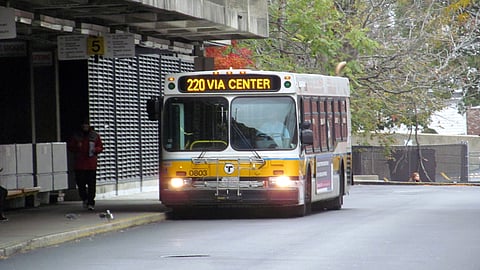


HINGHAM — An MBTA effort to improve ferry connections in Hingham is facing pushback from some Shipyard residents after new data revealed speeding concerns along the rerouted 220 bus route.
In August 2025, the MBTA closed two bus stops on Route 3A and relocated them to direct the bus toward the ferry on Shipyard Drive, creating more connections between Hingham and Boston. Assistant Town Administrator Art Robert said that the MBTA cited “increased ferry demand,” and data that the agency provided to Hingham shows that 65% of riders shifting from the closed Route 3A stops now use the Ferry Terminal stops. 35% now use stops at Lincoln Plaza.
GPS data from April and May showed that over 30% of buses drove over the speed limit while inbound to Quincy, and over 20% sped while outbound to Hingham. Data presented at the Select Board meeting did not share specific areas in which the buses were speeding, but Robert said that buses might be more likely to speed on the downhill stretch between Route 3A and the shipyard, which has an intersection without a northbound stop sign.
The number of inbound buses driving at or below the speed limit decreased by 3.3 percentage points between October 2025 and April 2026, and the number of outbound buses driving at or below the speed limit decreased by 4.1 percentage points in that period.
“There are some cases of buses going substantially over the speed limit,” Robert said. “Generally, those percentages of cases have declined, and I believe that reflects effort on the part of the MBTA to monitor speed, talk with their bus drivers and to be sure that they're thinking about that particular intersection.”
The MBTA reported .6% of buses driving 10 miles per hour over the speed limit inbound to Quincy between April 24 and May 2 of 2026, compared to 2.1% of buses between October 5 and 11 of 2025.
Town Engineer JR Frey proposed installing a speed feedback sign, which would measure the speed of oncoming vehicles and flash lights if that speed was over the limit, at the downhill intersection by the shipyard. Select Board members showed openness to the idea but said they were not prepared to vote on it.
Deputy Chief of Police Ryan O’Shea said that the police department has not received any calls reporting MBTA bus speeding in the past year, and neither the fire nor police departments have responded to accidents involving MBTA buses since the rerouting. Frey said that there has been no structural damage to roads in the shipyard area due to increased bus traffic.
But four residents spoke at the meeting to propose that the buses revert to their old route, citing noise, pollution and safety concerns along and near Shipyard Drive.
Resident Lynn Green complained that buses do not slow down enough at crosswalks and said that hundreds of pedestrians visit the shops by the shipyard on sunny days.
“I have called the MBTA several times on the speed,” she said. “More recently, [an MBTA representative] has been calling me back and telling me she feels that they're in the speed limit, not telling you what that speed limit is. We don't have posted speed limit signs in the shipyard.”
Resident Ruth Ann Stiles echoed Green’s claim that buses do not slow down at crosswalks. Valerie Cahill said that buses driving even small amounts over the speed limit can pose a significant danger on narrow, twisting roads near the shipyard.
“Five miles an hour over the speed limit feels different in that space than 3A,” Cahill said. “The bus can't even fit around the little rotary there.”
Green also claimed that the bus schedule does not align with the ferry schedule, hindering the MBTA’s goal of accommodating ferry users. And she worried that the 290 weekly buses could cause damage to the private roads in the shipyard area, which residents pay to maintain and repair.
“This has really impacted us,” Green said. “I am around in the shipyard a lot, and it's near and dear to me, and I want to be a partner with the town.”
About the South Shore Times
The South Shore Times is an independent, locally-owned digital news platform, free to readers, that covers communities south of Boston. Our articles are written by South Shore reporters, not AI.
For more South Shore news, subscribe to our newsletter.