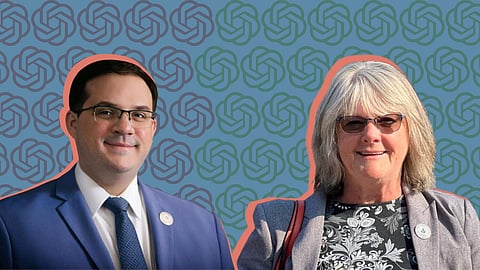


Questions about artificial intelligence—and honesty in government—took center stage at a March 12 Plymouth County commissioners meeting, where Chair Sandra Wright offered conflicting accounts of whether she used AI to help write an official statement.
Pressed by commissioner Jared Valanzola, Wright initially said she had used AI to shape the commission’s new “creed,” but later appeared to back away from that claim, prompting a broader debate over transparency and accountability.
“I gave most of my ideas and what I wanted,” Wright said. When Valanzola asked if she had used ChatGPT, she said, “Some of it was, just in general, but not all of it.”
Later in the meeting, she seemed to change her story: she said that she had used AI “in the past” and said of the creed, “I wrote this.”
“I'm not going to sit here and have an argument with you about whether I wrote it or whether I didn't write,” Wright said to Valanzola.
“The taxpayers at home deserve a straight answer from you, Madam Chair,” Valanzola later said.
Wright declined the South Shore Times’ request for comment, saying that she does “not usually talk to reporters.”
In an interview with the South Shore Times, Valanzola said that he is not comfortable voting in favor of any policy that may have been written using artificial intelligence.
“People voted for me. They didn't vote for ChatGPT. They did not vote for an AI document generator,” he said. “I believe I have a responsibility when I am making a vote on something to ensure that something is human."
The motion to adopt the creed passed with Wright and commissioner Gregory Hanley voting in favor. The creed will now be posted at Plymouth County buildings and emphasizes the importance of “unwavering integrity” and placing “the interest of our communities above all else.”
“We, the Plymouth County commissioners, believe that our member communities deserve leadership defined by strength, decisive action, and measurable results,” it reads. “We commit to showing up when it matters most, ensuring the voice of the county is present in the moments that define our future.”
When Valanzola continued pressing the issue of AI use after the motion passed, Wright said, “I think you had a very tough upbringing and you're angry,” and, “Do I have to ask you to leave the meeting?” Valanzola responded that she had "no right to do so."
Earlier in the meeting, when Wright stated that she had used generative AI to craft at least part of the creed, she said that she did not consider her AI use to be a cause for concern.
“These were my ideas, and it was just putting it in a format of how I wanted to get it out,” she said. “So I don't have any problem with it. And I will take note that this is what I put in my words, just a little more formal, a little bit better.”
Valanzola took issue with her potential use of generative AI because chatbots draw from other documents to generate their responses, which he worried could potentially be plagiarism.
“Artificial intelligence and ChatGPT utilizes readily available documents around the world. God knows from where,” he said in the meeting. “The idea that this could be borderline plagiarized is a significant problem. That's what ChatGPT does.”
Since the advent of readily available generative AI chatbots including ChatGPT, Claude, Google Gemini and Microsoft Copilot, more workforces—including governments—have encouraged its employees to use chatbots in their work. Massachusetts governor Maura Healey announced in February that the state had launched its own AI software powered by ChatGPT to make “government faster, more efficient, and more effective for the people we serve.”
Valanzola said that he had run the creed through two online AI detectors, which both said it was likely written in part or in full by AI.
But AI detectors frequently produce false positives and false negatives, according to studies published by the International Journal for Educational Integrity, the Institute of Electrical and Electronics Engineers, De Gruyter Bill, and other journals. Several academic institutions do not allow faculty to use AI detectors on students’ work due to the potential for inaccurate results.
When the South Shore Times ran Wright’s creed through seven common AI detectors, six of them claimed that it was written fully or partially by AI, and one did not detect any AI use. Each detector presented a different likelihood that AI was used to generate the statement.
“There should be a conversation at all levels about when AI is appropriate and inappropriate to use,” Valanzola said in an interview. “It’s a conversation that needs to be had by all stakeholders at every level of government in this country.”
For more South Shore news, subscribe to our newsletter.
About the South Shore Times
The South Shore Times is an independent, locally-owned digital news platform, free to readers, that covers communities south of Boston. Our articles are written by South Shore reporters, not AI.
