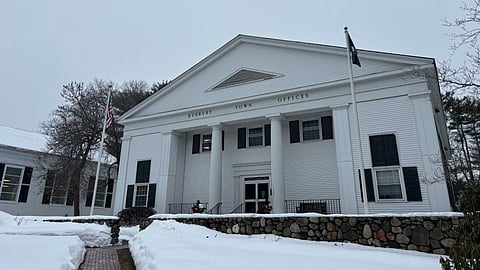


DUXBURY — The Duxbury Select Board voted to place a question on the annual town meeting ballot that would authorize the town to permanently raise the town’s property tax levy by $1.89 million beginning in fiscal year 2027, beyond the 2.5% increase allowed by state law. Voters will decide whether to approve the override at the March 28 town election.
Town officials said rising inflation, increasing health insurance premiums, and higher vendor and utility costs have made it increasingly difficult to present a level-services budget within Proposition 2½ limits. In response, Town Manager René Read outlined four override options designed to provide financial sustainability. The Select Board ultimately chose the smallest of the four proposed override amounts for the March ballot.
“We've got to keep the lights on in our buildings to educate our students and to have spaces for our police and fire to operate out of. We need to be able to absorb the impacts of those cost increases,” Finance Director Mary MacKinnon said. “And so that's exactly what the excess levy capacity is for.”
If passed, the override would add an estimated $325 to the average single-family tax bill in fiscal year 2027, Read said.
Board members chose the $1.89 million override over the other three more expensive options because they felt that it was the most likely to pass and the easiest to explain to residents. Unlike the other options, it includes no excess levy capacity, which is a temporary increase in taxes for a particular fiscal year.
Read explained that temporary state Student Opportunity Act funding inflated Duxbury’s long-term excess levy capacity figures by about $1.7 million in 2023. After removing that outlier, the town’s more typical unused taxing authority averages roughly $287,688 per year over the past 19 years. Board members ultimately declined to include additional excess levy capacity in the override question, saying a simpler figure would be easier for voters to understand and more likely to pass.
“I want to stay away from having a debate about what excess levy capacity is and what it does. It's not easy,” Select Board Member Fernando Guitart said. “Just go for the 1.8, we can communicate that to the community far easier. Let's get this override passed.”
Guitart said that the override would restore services that have been reduced and increase the number of public safety employees in the fire, police, and public works departments.
The override would also add new positions to the budget, and Select Board Vice Chair Amy McNab showed her opposition for one of the new positions, a full-time assistant beach operations administrator with a base salary of $83,025. Recreation Director Steve Studley said that making the position year-round despite reduced beach use in the winter would attract more qualified candidates.
Select Board Chair Brian Glennon proposed lowering the override by eliminating full-day kindergarten from the fiscal year 2027 budget. Duxbury plans to offer tuition-free full-day kindergarten next year following advocacy from the superintendent and the school committee, who say that most Massachusetts municipalities provide it. The current fiscal year 2027 budget proposal appropriates $450,000 for full-day kindergarten.
“Full day kindergarten is essential in 2026, and we're one of few communities in the state that are still burdening families for tuition,” superintendent Danielle Klingaman said.
Glennon argued that it is not required by state law and eliminating it would make the budget more “palatable to voters.” But the Select Board ultimately decided to place the $1.89 million override on the ballot without eliminating full-day kindergarten.
McGee hoped that voters would approve the override but noted that the town already raised beach, transfer station, boating, water and sewer fees to craft the fiscal year 2027 budget, and that voters will also be asked to consider a debt exclusion to study repair or replacement options for Alden School.
“Going into a year and explaining to people where that money is going, what services are needed, I think, is important to the voter,” Select Board member Michael McGee said. “These are extraordinary financial times created from COVID that we're still dealing with here, and I think we owe it to the public and to ourselves to muscle through this as best we can.”
For more South Shore news, subscribe to our newsletter.
About the South Shore Times
The South Shore Times is an independent, locally-owned digital news platform, free to readers, that covers communities south of Boston. Our articles are written by South Shore reporters, not AI.