
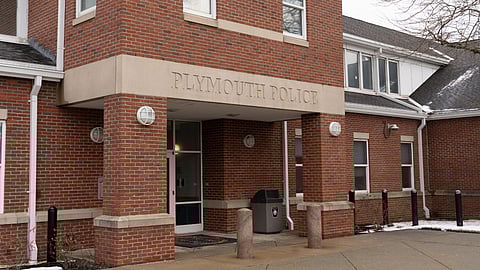
Q&A: Inside Plymouth Police’s Clinician Co-Response Program

PLYMOUTH — In 2022, the Plymouth police department became the first town in the South Shore to adopt a clinician co-response program, in which licensed mental health workers accompany police officers on calls to provide on-the-ground mental health services to those in crisis. As more towns in the regions start similar programs, the South Shore Times sat down with one of Plymouth’s clinicians, Mari Murphy, to talk about what clinician co-responders do and the effect they have on Plymouth.
This interview was edited for length and clarity.
Could you give an overview of what clinicians do in the police department?
We can do psychiatric evals for pretty much anyone and do referrals from inpatient hospitalizations to outpatient therapy; or if someone needs some check-ins, we can do that. We see kids all the way to elderly. Typically, we see as young as 4, and I've seen as old as 89, and anyone in between. We can do substance use referrals or mental health.
Why did Plymouth start this program?
It was basically to alleviate stress on the hospitals because the police were taking anyone who was suicidal or who needed any mental health treatment straight to the hospital. Now we can see anyone where they're at, whether it's the side of the road or in their home. We prevent unneeded hospitalizations, as well. It can help give resources to the community of Plymouth that they didn't know about.
Why is it important to prevent unnecessary hospitalizations?
In today's day and age, who wants a bill from the ambulance? People can’t afford it. Instead of having an ambulance at your home, you can have a clinician right there with a police officer. [It also respects] people's privacy—people don't want their worst day to turn out even a bit worse.
Some people don't need it. Some people, at that moment, need someone to talk to. We can check in with them pretty regularly. We can come back and do more of a face-to-face conversation the next day or a few days later.
We also wanted to prevent use of force from the police, and we've seen a decline [of that] over the past four years.
You mentioned that officer use of force has gone down. Can you elaborate on why you think that is? How do clinician programs help with that?
It's a deescalation tactic. People who might not want to talk to police, maybe they want to talk to a clinician.
I'm there almost every step of the way until they get to the hospital and [get] admitted. This program slows things down a little bit. With a police officer, I'm able to stay on a call a little bit longer than maybe all the officers would have alone. I'm able to do a little bit different work than a police officer.
At least in Plymouth, if someone needs to go to the hospital, we can give them the option to ride in the police cruiser or in an ambulance. It gives them a little bit more freedom.
Say someone says they are feeling suicidal. There [are] different forms of being suicidal. They can say, “I don't want to be here anymore” [or] “I have a plan, this is what I'm going to do.” Historically, that person has been told, “You have to go to the hospital, you have to,” and then they are just put in an ambulance… because the police are not qualified to tell if someone was actually going to do something. In those situations, [a clinician] can help prevent people feeling like they're being forced.
Why do you think it's valuable for the police department to have clinician co-responders?
I think the mentality within the police department in embracing the services has drastically changed over the last almost four years. The knowledge of police officers with mental health resources has also changed. People know where to go, who to talk to, and even if the clinician is not available, they can recite where to go, who to talk to as well. I've seen that, and I think the community has embraced it.
What kinds of calls do clinicians respond to?
I have responded to calls for someone who is having a psychotic episode. Sometimes it's a panic attack after a car accident. We've gone to children running away. We work alongside the group homes for adults and kids. In Plymouth, we are seeing anyone who is suicidal, as well. Those are mainly the kind of calls, sometimes domestic violence, as well, when needed.
I've done calls for death notifications. If a family member finds their family deceased, whether it be sudden, by suicide, whatever it might be, I can have services for the family member in the moment or a few days later. In cases with sexual assault, I can refer them to therapy, things like that after the fact, if they want.
What are some of the biggest challenges that clinician co-responders face?
As clinicians, we are exposed to a lot that other people will never see.
I'm really happy that more towns are utilizing clinicians. I've talked to many clinicians out of other towns, and I know there are a couple support groups that we can utilize to talk about these hard things that we might see.
But I know a lot of the officers will not expose us to anything that we don't need to be exposed to, but it's just the nature of almost being a first responder.
Why are clinician programs in police departments becoming more common in Massachusetts?
It's actually getting more popular across the US and in other countries. Policing is changing. People call the police for everything.
People call for a therapist and they're on a waiting list for God knows how long. It's a way to get services quicker for people who need it, essentially. I think that's why it's becoming more popular.
What work do clinicians do outside of responding to calls?
I write an evaluation from my notes that I have to write after each person I see. Because we're separate from the police department in that aspect, I have my own notes.
If there was someone who wanted to speak to a clinician [and] a clinician wasn't on overnight, we do follow-ups. I do some referrals to therapy as well, but we're mainly riding with the officer besides writing our notes. And we do some outreach when needed.
For more South Shore news, subscribe to our newsletter.
About the South Shore Times
The South Shore Times is an independent, locally-owned digital news platform, free to readers, that covers communities south of Boston. Our articles are written by South Shore reporters, not AI.