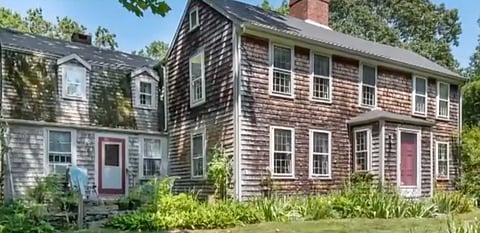


NORWELL — For nearly four centuries, the Jonathan Turner House has overlooked the North River, surviving generations of owners, the growth of Norwell and centuries of change. Now, what is believed to be the town's oldest home will remain protected long into the future.
The Select Board unanimously approved a preservation restriction for the Jonathan Turner House on Upper Ferry Lane at the June 24 meeting, permanently safeguarding the property's historic architecture, barn and landmark buttonwood tree through an agreement with Historic New England.
The decision fulfills the wishes of the home's longtime owner, Betsey Detwiler, who died in February. Detwiler wanted to ensure the family home could never be demolished or divided for redevelopment. The approximately two-acre property overlooking the North River had long been vulnerable to being purchased by a developer and split into two house lots.
According to Wendy Bawabe, President of the Norwell Historical Society, the earliest section of the Jonathan Turner House dates to 1645, making it the oldest surviving home in Norwell. The property occupies land originally granted to Humphrey Turner in 1636. His son, John Turner Sr., settled there in 1645, establishing a home and tannery that became the foundation for generations of the Turner family. Historical records document additions and expansions to the home during the early 1700s as succeeding generations continued to occupy the property.
Elizabeth Paliga, senior preservation services manager for Historic New England, told the board the preservation restriction will ensure the property's historic character is protected while allowing it to remain a privately owned home.
"Historic New England, formerly known as the Society for the Preservation of New England Antiquities, is a 501 nonprofit charitable corporation created in 1910. We operate across the six New England states and our mission is to preserve and share New England history through our own properties, landscapes, collections, and archives, but we also operate a nationally recognized preservation easement program to protect privately owned historic houses."
The Detwiler family donated the preservation restriction to Historic New England, a nonprofit organization that works with homeowners throughout the region to permanently preserve historically significant buildings.
The restriction protects both the exterior and interior of the Jonathan Turner House, including historic doors, windows, chimneys, foundations, framing, plaster and flooring. It also protects the property's historic barn and the centuries-old buttonwood tree that has become a defining feature of the landscape.
The preservation effort also reflects a broader goal shared by local preservation advocates. The Norwell Historical Commission encourages owners of older homes to consider preservation restrictions, noting that historic buildings built before 1925 contribute to the town's scenic character, strengthen property values and make Norwell unique.
Under Massachusetts law, preservation restrictions require approval from both the Massachusetts Historical Commission and the local municipality before becoming permanently binding. Historic New England has already received preliminary approval from the state.
Paliga emphasized that while the Select Board's approval is required, the agreement does not place any enforcement responsibility on the town.
"It's important to note that in approving this restriction, the town of Norwell assumes no responsibility nor accepts any liability for enforcement. This is a private agreement between Historic New England and the owners of this house."
Board members unanimously supported the proposal. Select Board Member Peter Smellie said he favored the restriction because it was voluntarily placed on the property by its owners and any future buyer would understand the home's protected status before purchasing it.
Following the vote, Select Board Vice Chair Lorenda Layne thanked the Detwiler family for their generosity.