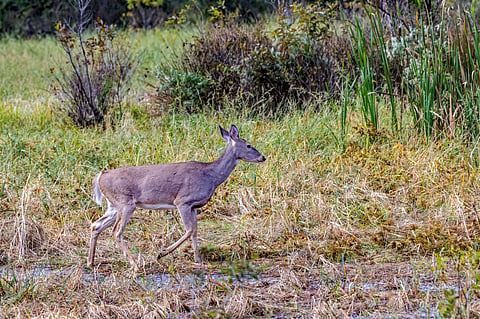


The growing deer population across eastern Massachusetts is doing more than eating gardens and increasing the chances of an encounter on the road. State wildlife officials say too many deer are beginning to alter coastal ecosystems, including beaches and salt marshes in southeastern Massachusetts.
“Across all of Eastern Massachusetts, deer abundance has grown substantially,” said Martin Feehan, PhD, Deer & Moose Biologist with the Massachusetts Division of Fisheries & Wildlife.
Feehan said deer populations are increasing statewide, but the problem is particularly pronounced in eastern Massachusetts. While the Cape has remained closer to the state's deer management goals, he said other areas of eastern Massachusetts are “substantially above” those targets.
Feehan said deer populations are increasing statewide, but the problem is particularly pronounced in eastern Massachusetts. While the Cape has remained closer to the state's deer management goals, he said other areas of eastern Massachusetts are “substantially above” those targets.
MassWildlife estimates that deer densities in parts of eastern Massachusetts can reach more than 30 to 50 deer per square mile. The agency's statewide management goal is generally 12 to 18 deer per square mile. Densities are even greater in some coastal areas with limited hunting access.
For South Shore communities, Feehan said the consequences can be seen in the vegetation and physical structure of coastal habitats.
“In those areas, we're at a point where you see substantial impacts,” Feehan said.
Deer feed on native vegetation in marshes and other coastal areas, reducing plant diversity and threatening rare plants. Their repeated movement along trails can also compact soil and alter how water moves into and out of salt marshes with the tides.
Those changes can have consequences beyond the deer themselves. The loss of vegetation can expose bare ground and affect coastal birds and other wildlife that depend on marshes and dunes for nesting and habitat.
MassWildlife highlighted the issue in a Sept. 3 report examining the effects of excessive deer populations on coastal ecosystems. The agency said deer can strip away beach grasses by browsing, bedding and repeatedly moving through the same areas. Those plants play an important role in holding dunes together and limiting erosion.
The issue comes as much of the state's coastline is already under pressure. MassWildlife, citing the Massachusetts Office of Coastal Zone Management and U.S. Geological Survey, said approximately 68% of the Massachusetts shoreline is experiencing long-term erosion, with some particularly vulnerable locations losing as much as 12 feet of coastline annually.
Deer are not causing that broader erosion problem, but Feehan said high populations can make the damage worse by removing vegetation that helps stabilize coastal areas.
The most dramatic examples are currently visible on Nantucket, where Feehan said some heavily used areas have been browsed nearly to bare sand.
“There are whole sections where the deer have browsed all the way down to the sand,” Feehan said. “Their bedding areas essentially were bare sand where there should be vegetation.”
Similar signs are beginning to appear in southeastern Massachusetts, Feehan said, including near beaches where vegetation important to holding the coastline in place has been lost.
Deer are particularly capable of moving into coastal environments because white-tailed deer are highly adaptable. They are also strong swimmers.
Feehan said deer are regularly observed swimming between the Boston Harbor Islands and have been seen in the Cape Cod Canal and in bays around Martha's Vineyard and Nantucket.
High deer populations can also affect salt marshes in ways that are less immediately visible. MassWildlife said frequently used deer trails can compact marsh soil, destroy vegetation and reduce the soil's ability to absorb water during tidal cycles. That can expose sediment to additional erosion as tides and storms move through the marsh.
The ecological effects can spread further. MassWildlife said excessive deer activity can damage habitat used by rare plants and coastal birds, including roseate terns and saltmarsh sparrows.
Another concern frequently associated with deer is ticks.
Feehan said there is a well-established relationship between deer and black-legged ticks, which can transmit Lyme disease, but cautioned that reducing deer numbers does not produce an equivalent reduction in ticks.
Once deer densities reach roughly eight to 10 animals per square mile, Feehan said, there can be enough hosts to support a substantial tick population. Reducing deer numbers can still make other tick-control strategies more effective, but deer management alone will not eliminate ticks.
For wildlife officials, the primary tool for reducing excessive deer populations remains regulated hunting.
“Hunting is certainly the primary way of addressing it,” Feehan said.
Feehan said every state uses deer hunting as its primary population-management method. MassWildlife has also expanded hunting opportunities in several coastal wildlife management zones as officials try to bring deer populations closer to ecological targets.
Local communities can play a role as well. Feehan said municipalities can examine bylaws that limit hunting access, while private landowners can permit hunters to use their property where hunting can be conducted legally and safely.
“There’s quite a few towns that have bylaws that are restrictive to hunting and those have a significant impact of being able to reduce the amount of harvest,” Feehan said.
Without the same predator pressures that historically helped regulate deer populations, Feehan said Massachusetts landscapes can now support unusually high deer densities. In coastal communities already confronting erosion and changing environmental conditions, the effects can compound existing problems.
“We are able to support very high deer densities,” Feehan said, “and that has really negative impacts [on] ecosystems.”