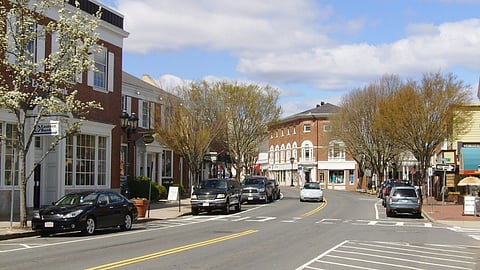


PLYMOUTH — The town's Downtown Resiliency Project completed plans for phase one of a major construction project that could lower temperatures and energy use between Main Street and Samoset Street, said the town’s climate resiliency and sustainability planner in a Jan. 29 Select Board meeting.
The project aims to redevelop and redesign 3,000 linear feet in the downtown area to be safer, healthier, and more resilient in the face of climate change. Currently, downtown Plymouth is an urban heat island, an area with dark asphalt or concrete infrastructure that “attracts and retains heat,” said Climate Resiliency and Sustainability Planner Michael Cahill in a presentation about the project. Using lighter materials and planting trees to provide shade can lower outdoor temperatures, which in turn can reduce electricity costs to power air conditioning. Phase one would attempt to lower temperatures in downtown Plymouth by introducing vegetation to Shirley Square, Depot Square Park and Main Street Corridor.
Extreme heat is the number one cause of weather-related fatalities in the United States, and temperatures have been climbing in Massachusetts: according to data from the Northeast Regional Climate Center, the average annual temperature in Massachusetts has been trending upward for decades. Cahill said the number of days over 90 degrees per year has begun to increase.
“The best way to combat urban heat island is through the planting of street trees and urban vegetation, which is what we are proposing in this project: utilizing green infrastructure to help cool these areas,” he said.
Besides providing shade, Cahill said street trees could improve stormwater runoff management. Stormwater runoff can carry urban waste to nearby waterways—in Plymouth’s case, the harbor. Trees can reduce runoff by absorbing water in their roots and providing more surface area for rain to land on and evaporate.
Reduced temperatures could also encourage residents to spend more time downtown, which could positively impact local businesses, Cahill said.
“There is a human cost, as well as an economic cost, to having a heat island in our economic center,” Select Board Member Kevin Canty said.
The project received about $126,000 from the town for construction design at its inception in 2023, and later received a grant of roughly $362,000 from the Municipal Vulnerability Preparedness Reaction Grant, a state grant that funds adaptations that address climate change.
Managers of the project will apply for another $3 million from the MVP Action Grant in March for construction funding. If the application is successful, it will request matching funds from the town at the annual town meeting, Cahill said. Construction for phase one would be complete in spring 2028.
He also said that the project decided to split construction into two phases so that each phase could qualify for MVP Action Grant funding, which has a scope of two years.
“The scope of the project had grown to a point where we wouldn't be able to conduct all the construction within that two year window, so we elected a phase out,” Cahill said. “It allows us to go back to MVP twice for two bites of the apple at $3 million, limiting taxpayer funding, limiting town funding going towards the project.”
Select Board Member Bill Keohan commended the effort to plant more trees downtown, saying that Plymouth used to have more trees downtown and in village centers. He also urged the project to consider replacing heat-absorbing asphalt and concrete with “historically sensitive” materials that he said would improve both the cooling and aesthetics of Town Square.
If the project obtains all of the necessary funding, managers plan to have a complete design of phase two in Spring 2028, in time to apply for another MVP grant in March 2028 as phase one construction is completed.
Phase two would focus on Town Square, Court House Green, and the Main Street Extension Parking Lot. Construction would be completed in 2030 according to current plans.
The total cost estimate for designing and permitting phase two is about $175,000. The project already has about $60,000 from the town for that purpose, so it will make a capital request for the remaining $115,000 in Spring 2026.
The total cost of the project is estimated to be $4.8 million, though that number is subject to change.
For more South Shore news, subscribe to our newsletter.
About the South Shore Times
The South Shore Times is an independent, locally-owned digital news platform, free to readers, that covers communities south of Boston. Our articles are written by South Shore reporters, not AI.